

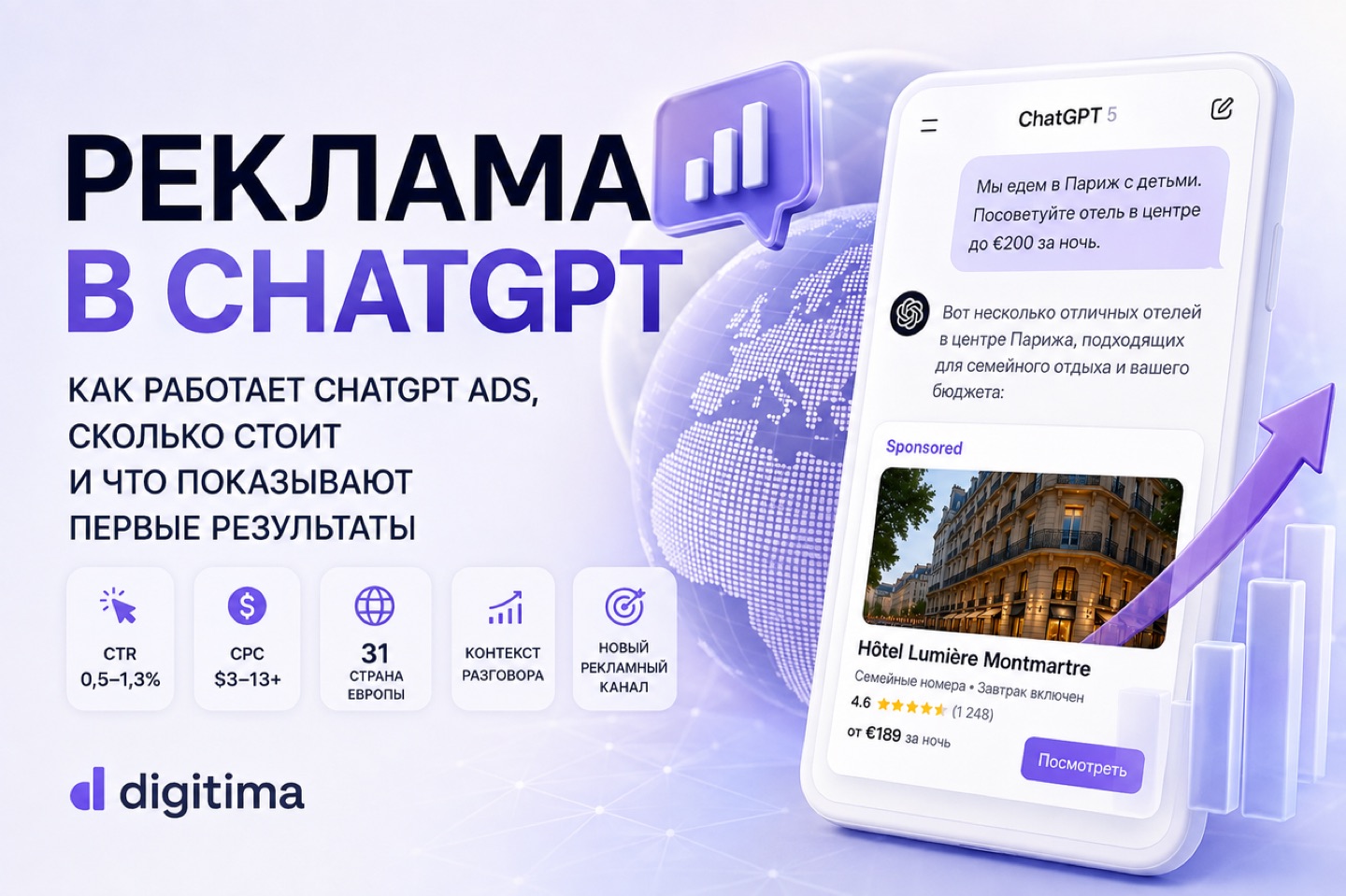
ChatGPT is gradually becoming not only an AI service, but also a new advertising platform.
This article is based on data and examples available on 25 August 2026. Geography, buying conditions and tool availability continue to change: according to OpenAI’s 21 October 2026 announcement, advertising was already available in 89 countries. Check ChatGPT Ads Help for current country access and conditions. The benchmarks below are historical observations, not performance guarantees.
OpenAI began testing advertising in the United States in February 2026, later expanded ChatGPT Ads into several more markets, and on 24 August 2026 launched advertising in another 31 European countries.
The main difference between ChatGPT Ads and Google or Meta is not the ad format, but the conversation context.
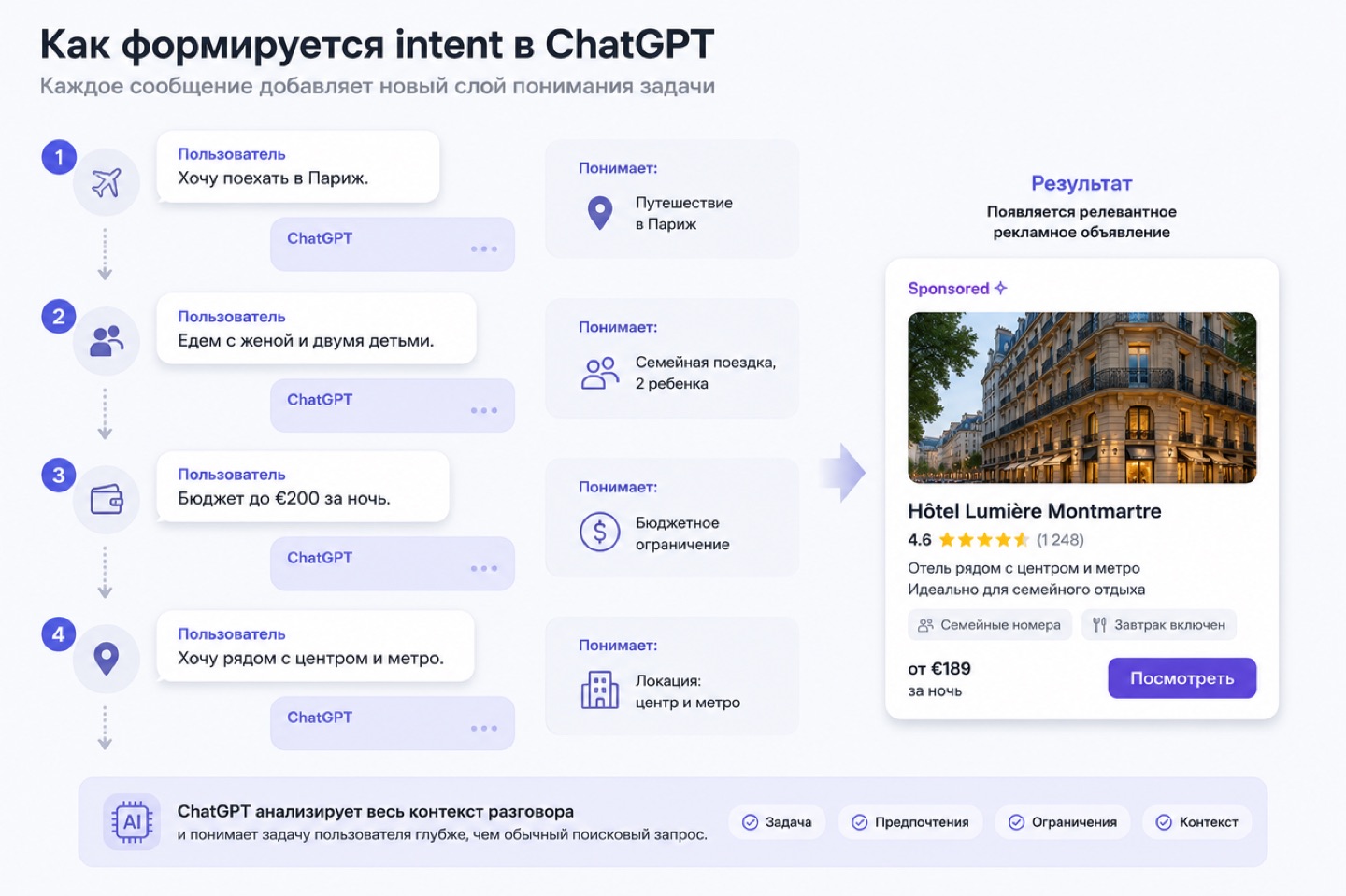
Instead of entering only “hotel Paris”, a user can explain where they are going, who is travelling, their budget and priorities. The advertising system therefore works not only with an isolated search query, but with gradually formed conversational intent.
Here is how ChatGPT Ads works, where it is available, what it may cost and what early campaigns show.
What advertising in ChatGPT looks like
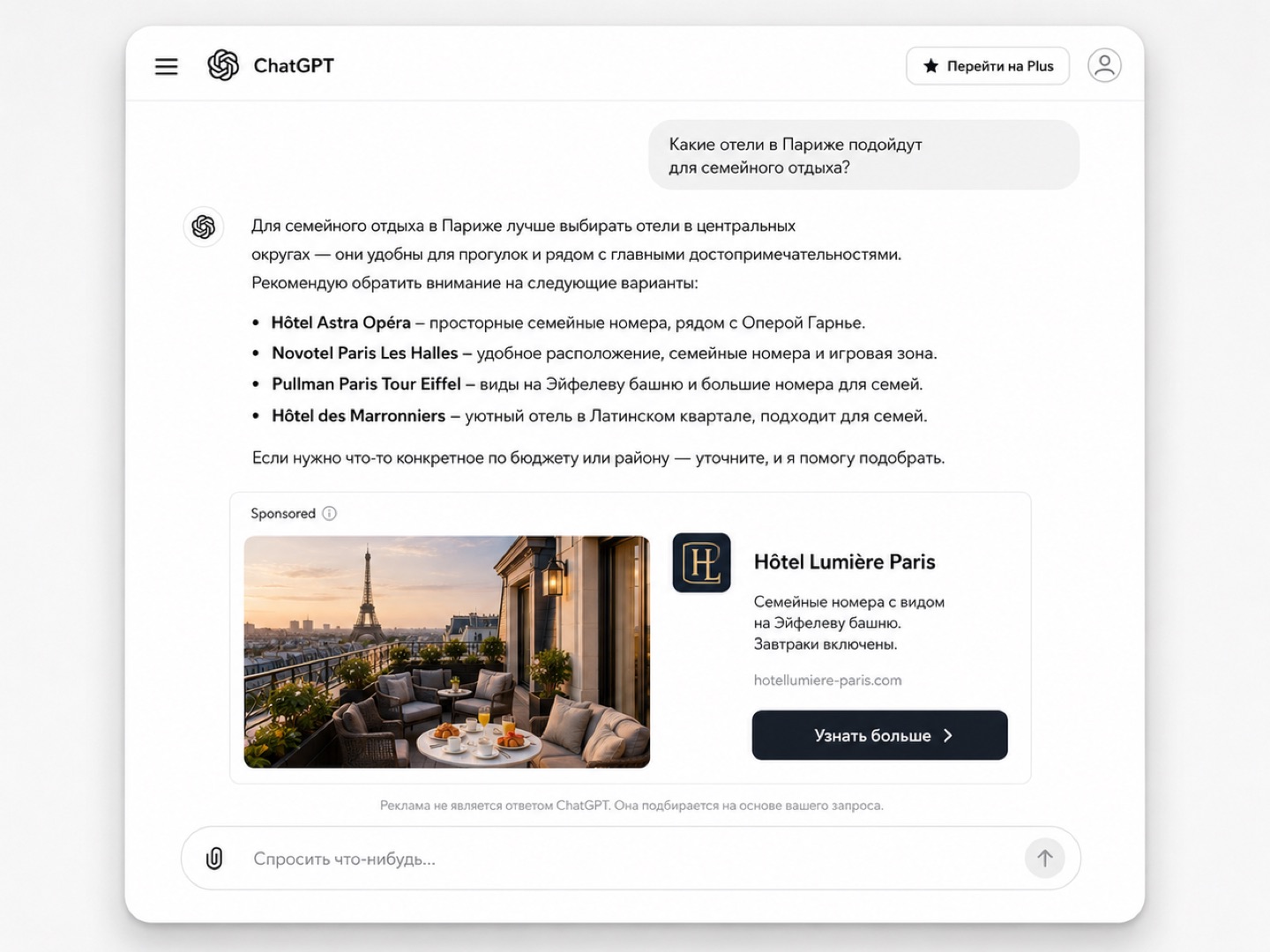
Advertising appears separately from the ChatGPT answer and is labelled Sponsored.
An advertiser cannot pay to change the model’s answer itself.
An advertising card can include:
- advertiser name;
- logo;
- headline;
- description;
- landing page;
- image.
ChatGPT Ads is therefore not limited to text advertising.
There is no separate price for an ad “with an image” or “without an image”. Cost is determined by the buying model, bid and auction outcome.
Who sees the advertising
Ads are shown to users on:
- Free;
- Go.
They are not shown to users on:
- Plus;
- Pro;
- Business;
- Enterprise;
- Edu.
Advertising is also not shown to underage users.
This matters for B2B: some of the most active professional users may have paid subscriptions and never enter the advertising inventory.
Where ChatGPT Ads is available
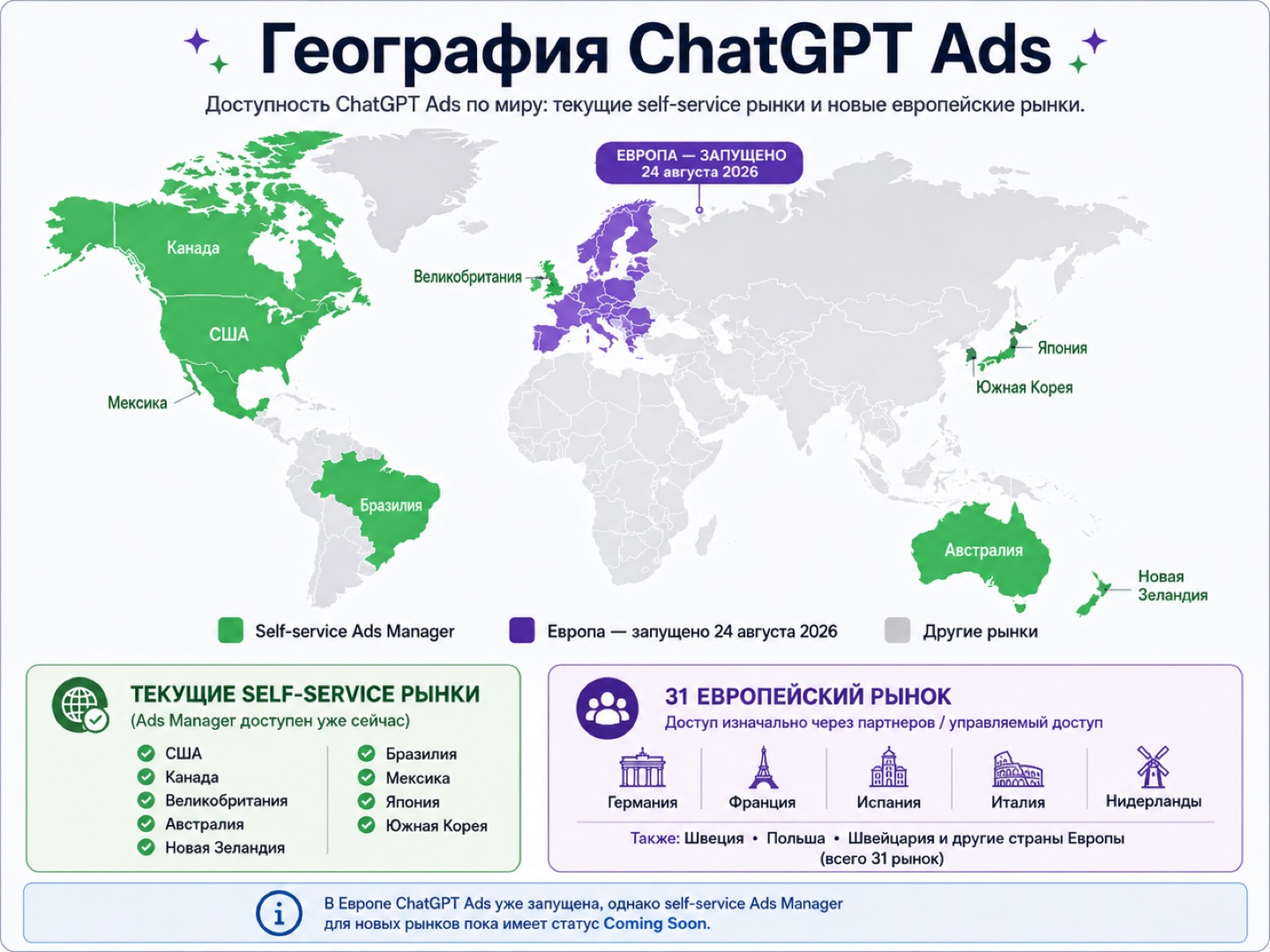
Before the European expansion, the self-service Ads Manager already operated in nine countries:
🇺🇸 United States
🇬🇧 United Kingdom
🇨🇦 Canada
🇦🇺 Australia
🇳🇿 New Zealand
🇧🇷 Brazil
🇲🇽 Mexico
🇯🇵 Japan
🇰🇷 South Korea
On 24 August 2026, ChatGPT Ads expanded into another 31 European markets, including Germany, France, Spain, Italy, Austria, the Netherlands, Sweden, Norway, Poland, Switzerland and others.
An important qualification:
Launching advertising in Europe did not immediately mean full self-service access.
On 25 August, the new European markets still showed Coming Soon in Ads Manager.
At the first stage, placements were available through:
- OpenAI Ads Solutions;
- advertising agencies;
- technology partners.
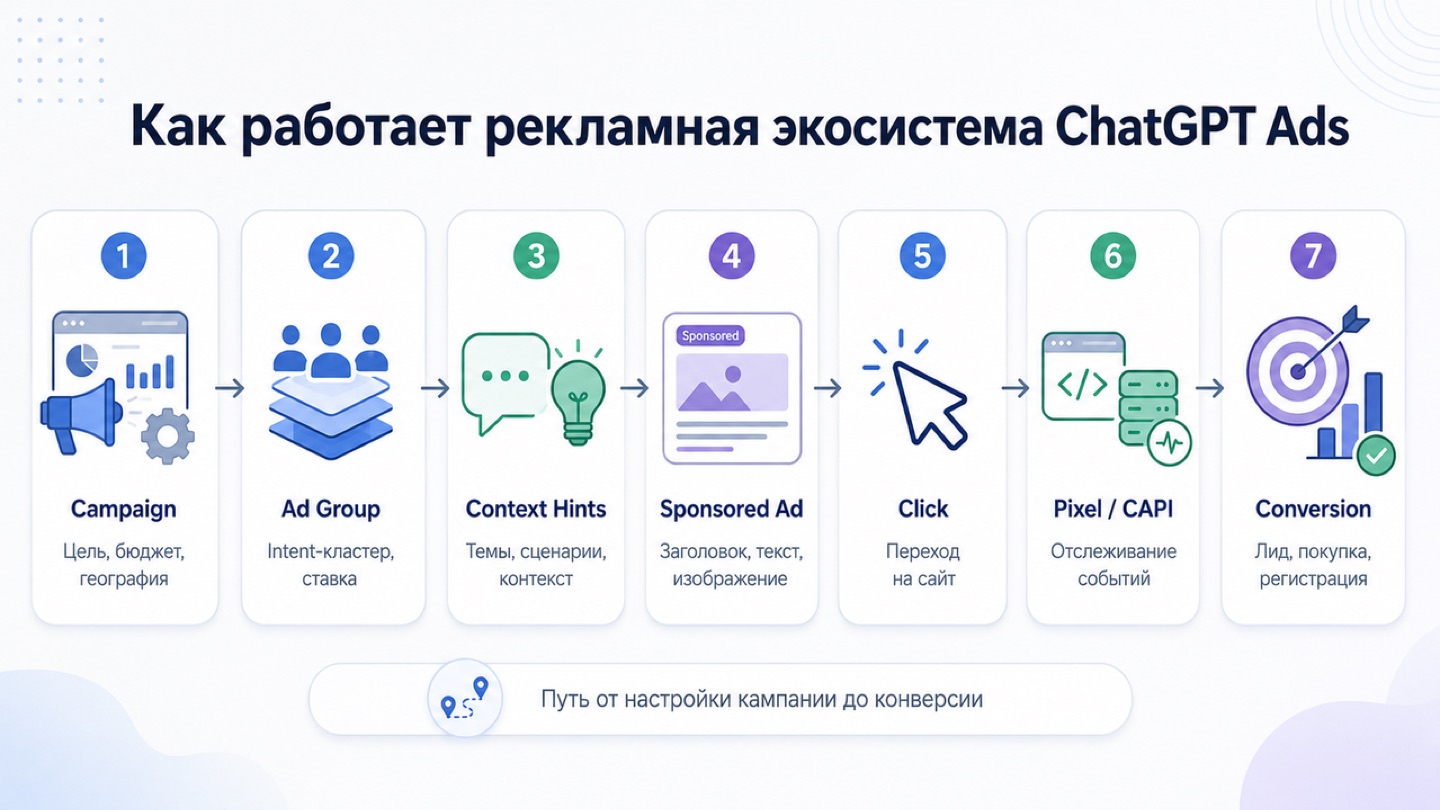
How Ads Manager is structured
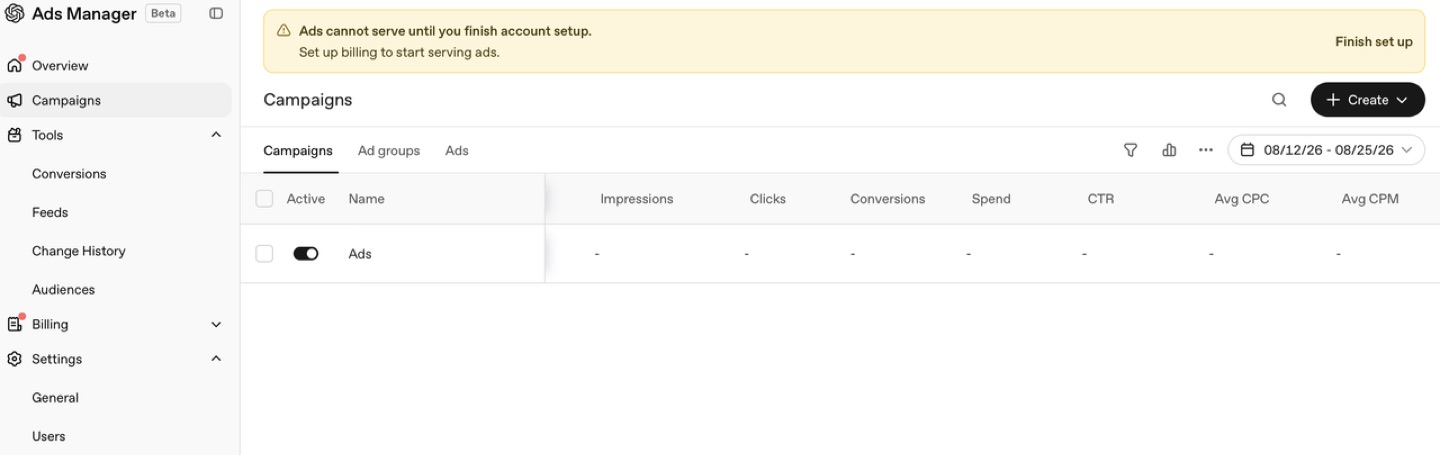
The account structure resembles other performance platforms:
Campaign
Objective, budget, dates, geography, platforms and audiences.
↓
Ad Group
Intent cluster, Context Hints and bid.
↓
Ad
Headline, description, image and landing page.
Buying models
The main models are:
CPM
Payment per 1,000 impressions.
CPC
Payment per click.
oCPC
CPC optimised towards users who are more likely to convert.
Importantly, oCPC is not CPA. The advertiser still pays for the click, not the purchase or lead.
Minimum budget
In the United States, the minimum daily budget starts at approximately $25 per day.
However, the minimum budget and a sufficient performance-test budget are different. If actual CPC is $10–12, a $25 daily budget generates only two or three clicks.
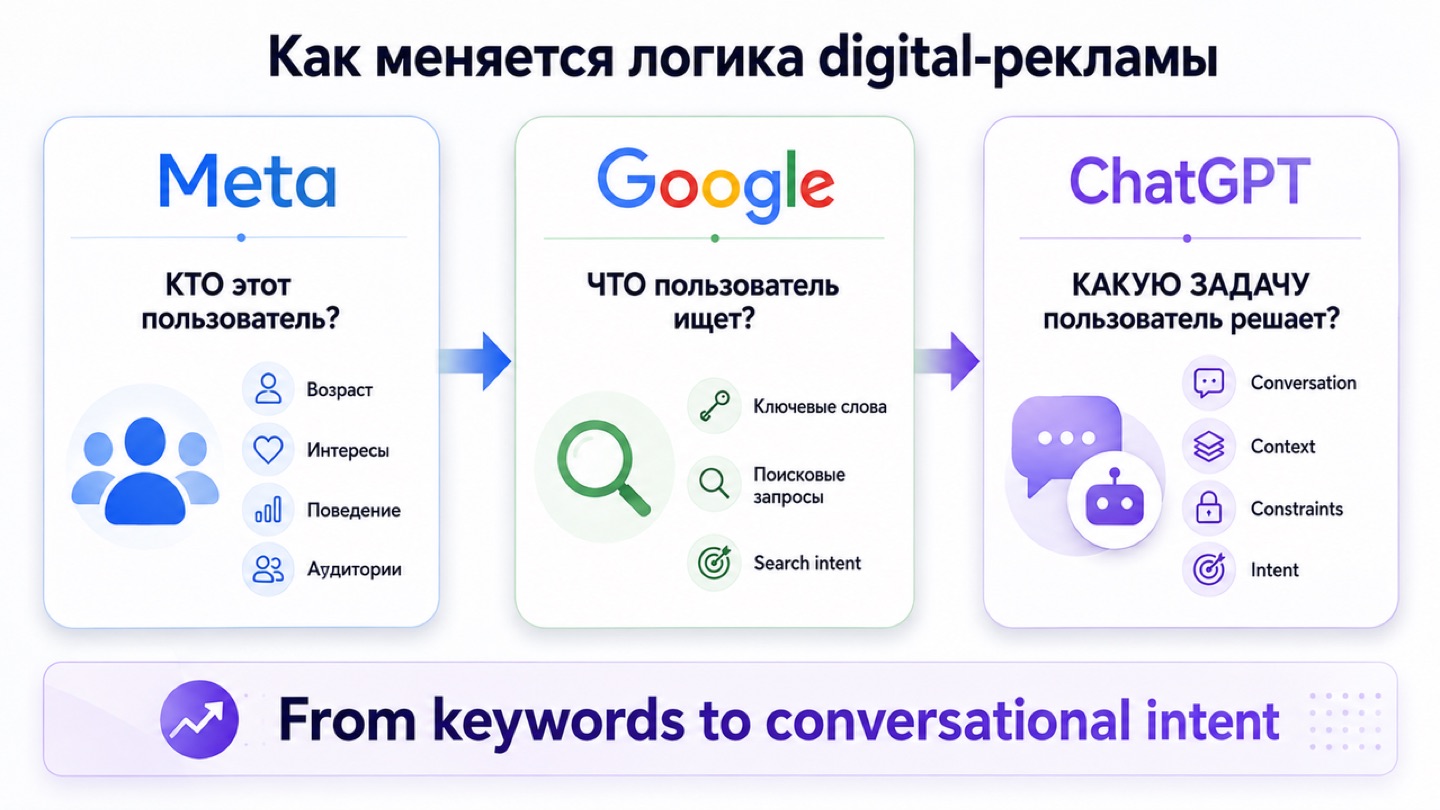
The central difference: Context Hints
Meta advertising is built around the question:
Who is this user?
Google asks:
What are they searching for?
ChatGPT asks:
Which problem are they solving now?
In simplified form:
Meta → Audience → Ad
Google → Keyword → Search Intent → Ad
ChatGPT → Conversation → Context → Intent → Ad
How Context Hints work
Instead of a standard keyword list, the advertiser describes situations and conversations in which the product may be useful.
For a hotel, for example:
travelers planning a family trip to Paris
families comparing central Paris hotels
travelers looking for accommodation near metro stations
families searching for hotels within a specific budget
These are not exact-match keywords.
The system tries to understand the meaning of the conversation and the user’s intent.
Why this is interesting
A standard query such as:
car rental Spain
provides relatively little information.
A ChatGPT conversation may say:
“My wife and I are travelling to Spain for two weeks with our two children. We want to collect a car in Barcelona and return it in Madrid. We need an automatic transmission, a large boot and two child seats.”
This already contains an almost complete advertising brief:
Product: car rental
Country: Spain
Pickup: Barcelona
Drop-off: Madrid
Audience: family
Children: 2
Transmission: automatic
Need: child seats
This is the core potential of conversational advertising.
Other targeting options
In addition to Context Hints, ChatGPT Ads supports:
- geotargeting;
- platform targeting;
- Custom Audiences;
- conversion optimisation.
Campaigns can cover Web, iOS and Android.
Advertisers do not receive access to users’ conversations or chat history.
Pixel and Conversions API
Results are measured through:
OpenAI Pixel
and
Conversions API.
Ads Manager reports:
- impressions;
- clicks;
- spend;
- CTR;
- Average CPC;
- Average CPM;
- conversions.
What early real-world results show
The platform is too young for stable benchmarks, but several early datasets are informative.
CTR
According to Similarweb:
Overall CTR — around 0.68%
Median CTR:
around 0.50%
Top quartile:
around 1%
Best individual results:
up to 5.4% CTR
In an SE Ranking test:
- 97,000+ impressions;
- 1,263 clicks;
- CTR — 1.30%.
An early market range of 0.5–1.3% CTR may therefore be useful for orientation, but it is not an official OpenAI benchmark.
Observed CPC
In 2POINT cases:
B2B software
CPC — $5.25
B2C home services
CPC — $3.27
Some examples are significantly more expensive.
One real screenshot showed:
Campaign 1
3,270 impressions
41 clicks
$468.54 spend
CTR — 1.25%
CPC = $11.43
Campaign 2
7,678 impressions
79 clicks
$1,000 spend
CTR — 1.03%
CPC = $12.66
The actual click cost can therefore differ considerably from expectations.
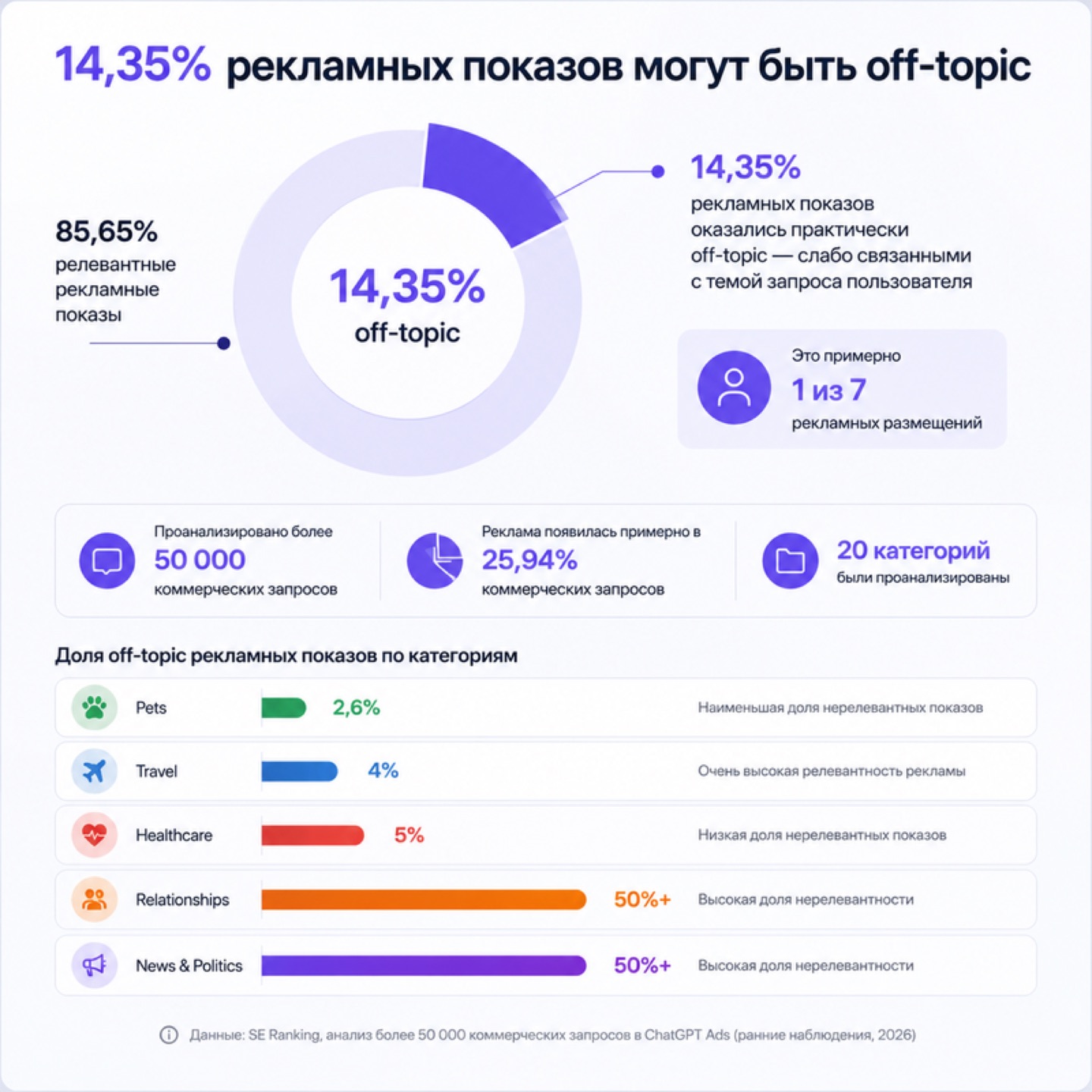
14.35% of placements may be off-topic
SE Ranking analysed more than 50,000 commercial prompts across 20 categories.
Advertising appeared in approximately 25.94% of commercial prompts.
At the same time, 14.35% of ad placements were effectively off-topic.
That is roughly one in seven placements with a weak thematic connection to the user’s request.
This does not mean 14% poor traffic after the click. It specifically describes advertising matching quality.
Results vary significantly by category
Pets — 2.6% off-topic
Travel — 4%
Healthcare — 5%
Relationships — over 50%
News & Politics — over 50%
Travel appears particularly promising: approximately 96% of placements were thematically connected to the request.
Why irrelevant matches occur
Google provides relatively strict control through:
keyword → search term → negative keyword
ChatGPT tries to understand:
conversation → context → intent
This is potentially much more powerful, but currently gives advertisers less control.
There is also no full equivalent of the Google Search Terms Report: an advertiser does not receive a list of real conversations in which the ad appeared.
Clicks can be strong while conversions remain weak
SE Ranking achieved a good 1.30% CTR but very few registrations.
This highlights an important distinction:
Conversational intent is not always purchase intent.
A user may be researching a subject and comparing options while still being far from purchase.
B2B carries a separate risk
If the audience actively uses Plus, Pro or Business, it will not see advertising.
B2B advertisers should therefore evaluate not only the size of the ChatGPT audience but also its subscription structure.
Advertising does not buy a place in the AI answer
In the SE Ranking study, in 96.37% of cases the advertiser was not a source for the ChatGPT answer beside which its ad appeared.
Sponsored placement and organic AI visibility are separate tasks.
ChatGPT Ads and GEO/AEO should therefore be managed as distinct workstreams.
Advertising can appear deep in a conversation
According to Similarweb, around 44% of ad impressions occur on the first message and around 56% appear later. The average conversation containing advertising has around 17 messages.
By the time the ad appears, AI may already understand the user’s:
- task;
- budget;
- preferences;
- constraints;
- alternatives.
83% of advertising prompts do not map neatly to a standard keyword
The final message before an ad may be as simple as:
“Yes”
“What about the second option?”
“I need something cheaper”
On its own, the message says almost nothing to an advertising system. The context comes from the full preceding conversation.
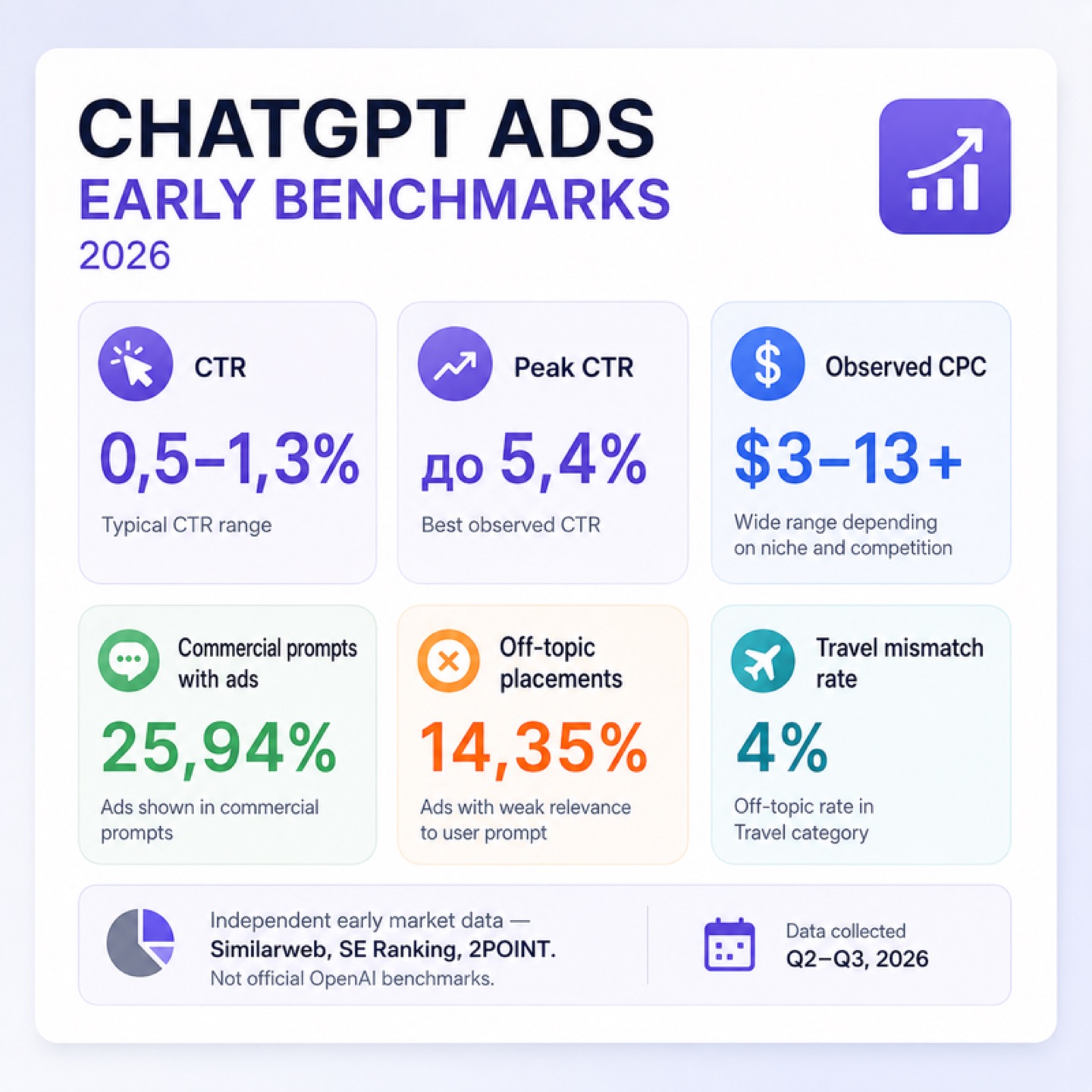
Early benchmarks
Independent data currently suggests approximately:
CTR: 0.5–1.3%
Peak CTR: up to 5.4%
Observed CPC: $3–13+
Commercial prompts with ads: 25.94%
Off-topic placements: 14.35%
Travel mismatch: 4%
These are early market observations, not official OpenAI benchmarks.
What this means for advertisers
The early evidence supports several conclusions.
1. ChatGPT Ads is no longer a local experiment
After its European expansion, the platform is becoming an international advertising channel.
2. The channel cannot yet be called inexpensive
CPC may be around $3–5, but can exceed $10–12 in individual campaigns.
3. CTR appears viable
But a good CTR does not guarantee strong conversion.
4. Matching is still imperfect
An off-topic rate of 14.35% is material.
5. B2B requires particularly careful testing
Some target users are on paid, ad-free plans.
6. Paid and organic AI visibility are different objectives
ChatGPT Ads does not replace work on brand presence inside AI answers.
Which categories appear most promising
Products with a long research and comparison stage are logical early candidates.
✈️ Travel
Hotels, flights, insurance and car rental.
💻 Technology
Laptops, smartphones and SaaS.
🎓 Education
Courses and online learning.
🛍 E-commerce
Products with a long consideration cycle.
🚗 Automotive
Vehicles, rental and related services.
🏢 B2B
CRM and SaaS, with the limitations of Free/Go inventory in mind.
What about Uzbekistan?
As of 25 August 2026, Uzbekistan was not included among countries with self-service Ads Manager access.
Local campaigns could therefore not be launched directly through Ads Manager at that point.
For companies in Uzbekistan, ChatGPT Ads was primarily relevant as a channel for international markets:
- tourism;
- SaaS;
- education;
- IT;
- export;
- international e-commerce.
How to test ChatGPT Ads
Do not copy a Google Ads structure one-to-one.
Build campaigns around real user tasks.
Not:
Paris hotel
But:
a family travelling to Paris with children;
budget up to €200;
central location;
metro access matters;
the user is comparing several hotels.
These scenarios form intent clusters.
After launch, assess not only CTR and CPC, but also conversion rate, CPA, revenue and ROAS.
What ChatGPT Ads may change in digital advertising
Meta primarily answers: Who is this user?
Google: What are they searching for?
ChatGPT: Which problem are they trying to solve now?
That is the central difference.
An AI user gradually describes a problem, clarifies requirements, compares options and moves towards a decision.
The advertising system may therefore gain access not merely to search intent, but to decision-making context.
It is too early to treat ChatGPT Ads as a replacement for Google or Meta. Matching remains imperfect, benchmarks are still forming and CPC can be high.
But after expansion into 31 European markets, it is clearly no longer a small experiment.
It marks the beginning of a new digital advertising category: advertising inside AI conversations.